

The Mang-U and Mangun Groups among the Letu/Laytu (Chin) People
The Mang-U group and the Mangun group are not the same, although the two names are sometimes confused.
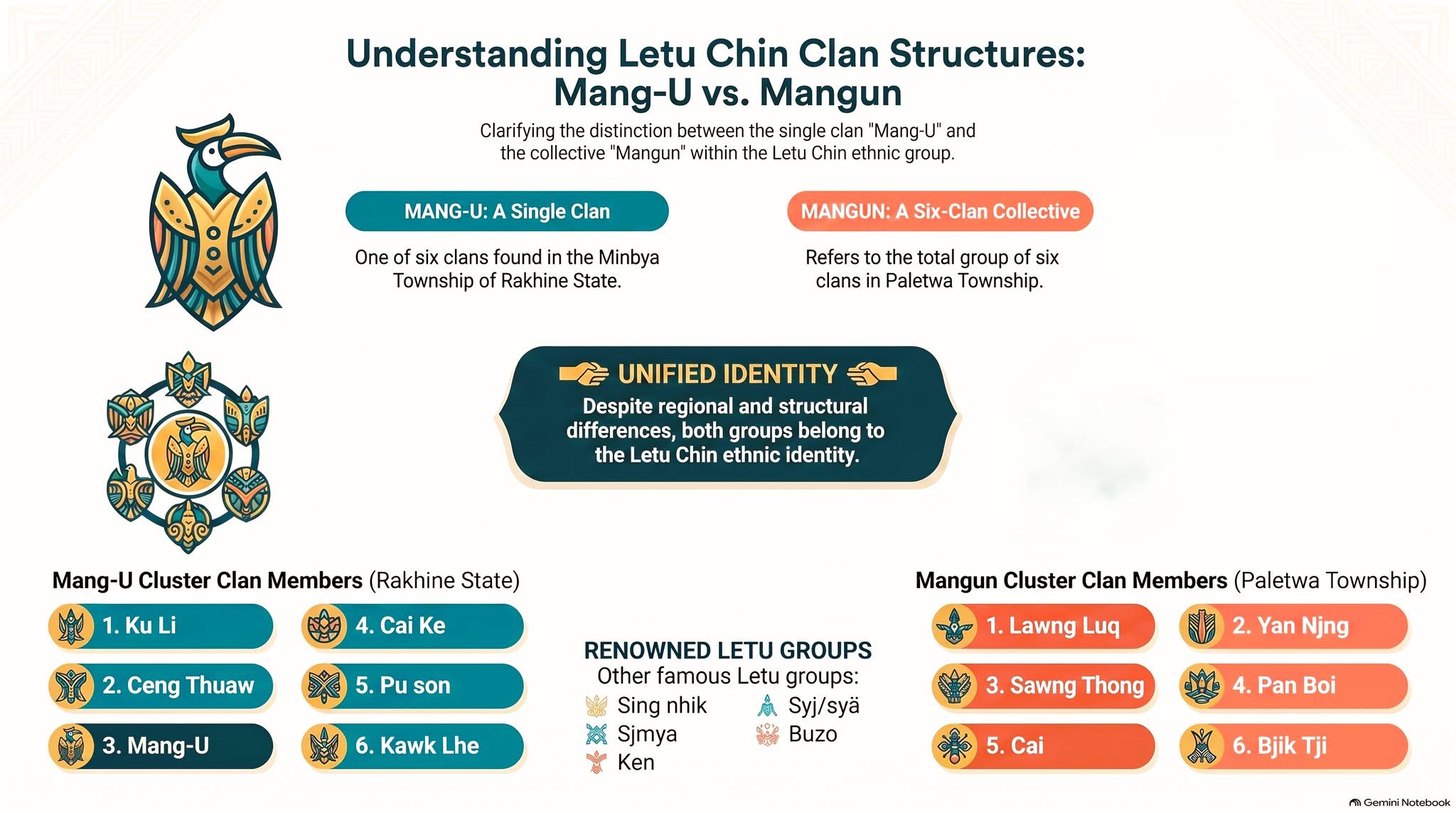
The Letu/Laytu (Chin) people are traditionally organized into a number of groups and subgroups. A question sometimes arises as to whether the Mang-U people—who reside in the Zaing Chaung–Pauk Taw village tract of Minbya Township in Rakhine State, the Telong region, and surrounding areas—are the same as the Mangun people, who are found in the Than Htaung area of the Lemro region in Paletwa Township, southern Chin State.
The distinction is important. Mang-U refers to one particular cluster, whereas Mangun is a broader collective designation comprising six clusters. Thus, although Mang-U is associated with this wider ethnocultural classification, the terms Mang-U and Mangun should not be used interchangeably.
Six Clusters Including Mang-U
The following six clusters are identified within this grouping:
- Ku Li
- Ceng Thuaw
- Mang-U
- Cai Ke
- Pu Son
- Kawk Lhe
Six Clusters of the Mangun Group
Hphone Laung, Paletwa Township
The Mangun group in the Hphone Laung area of Paletwa Township is likewise composed of six clusters:
- Lawng Luq
- Yan Njng
- Sawng Thong
- Pan Boi
- Cai
- Bjiq Tji
This pattern of internal organization is not unique to the Mangun. Other groups among the Laytu (Chin) people are also traditionally organized into six clusters.
Within the Lai (Phunglong) group, for example, subgroups such as Sing Nhik, Sjmya, Ken, Syj/Syä, and Buzo are also well known. Despite their distinct subgroup names and identities, they belong to the broader Lai (Chin) ethnic community.
Understanding these distinctions is important for accurately documenting the historical and ethnographic identities of the Laytu (Chin) people. Similarities in names should not be taken to mean that two communities are identical. Rather, the relationship between a particular cluster and a broader collective group must be understood within the traditional social and ethnic organization of the people.
Translator’s and Editor’s Note:: This article has been translated and adapted from information provided by Min Thang. The English version has been edited and arranged in an academic tone while seeking to preserve faithfully the substance of his original account.

.jpeg)
.jpeg)
